Every year on 5 October my phone picks up a few messages from former students. Some are short, just "Happy Teachers' Day, sir." Others remind me of a lab session I had long forgotten, the moment a router finally replied to a ping or a concept finally made sense. Those messages are the best part of this work. They also remind me that teaching is not really about the hour we spend in the lecture room. It is about what stays with a person long after they have left it.
So today I want to celebrate teachers. Not in a ceremonial way, but honestly, from inside a Ugandan university classroom. I teach applied computing and information technology at Makerere University Business School (MUBS), and I work with colleagues on e-learning in the Faculty of Computing and Informatics. From where I stand, teachers are holding communities together under a kind of pressure most people never see. That deserves to be said out loud.
World Teachers' Day has been marked since 1994 to remember the 1966 ILO/UNESCO Recommendation concerning the Status of Teachers. This year marks 60 years of that document, under the theme "Standing with teachers: 60 years of protecting the profession, advancing its status and shaping our futures" (UNESCO, World Teachers' Day). University teachers are included too, through the 1997 Recommendation concerning the Status of Higher-Education Teaching Personnel. UNESCO and the Teacher Task Force estimate the world needs 44 million more primary and secondary teachers by 2030, with about 15 million of them needed in sub-Saharan Africa (UNESCO, Global report on teachers). Behind that statistic are real Ugandan classrooms with too many learners, too few hands, and teachers who still show up every morning. That is the backdrop against which I meet my own students.
Teaching Gen Z, and what they ask of us
My students grew up with Wi-Fi, WhatsApp groups and short videos. They are quick, curious and very honest about what bores them. If a slide has twelve bullet points, I lose them by the fourth. If I open with a real problem, say a company network that went down on a Monday morning, the questions start before I finish the story.
I used to read this as a short attention span. I now think it is a different contract. Gen Z learners want to know why something matters before they give it their time. That is a fair request. The answer has to come early, and it has to be real. They also care about fairness and about being seen. A student who feels like a registration number will do the minimum. A student who hears their name and gets honest feedback will often surprise you.
That same honesty cuts both ways. Many students attend because attendance is counted, not because they want to be there. Some sit at the back with earphones in. Some sign the register for a friend. Copying has become casual, and lifting a whole assignment from a group chat no longer feels like cheating to some learners. It feels like teamwork.
It is easy for us teachers to say morals have decayed. I have said it myself after a long weekend of marking. But complaining does not change a classroom. What I have seen work is slower and more personal. I explain why integrity matters in the work they are preparing for. In cybersecurity, which I also practise outside the classroom, a person who fakes a result or shares a password "just this once" can cost an organisation everything. When students see honesty as a professional skill and not a sermon, the conversation changes. In this setting a teacher is much more than a content provider. We model what a responsible adult looks like: keeping time, admitting mistakes, treating people with respect, and saying no when something is wrong. Students notice. Even the ones at the back. And that modelling matters even more when every learner already carries a library in their pocket.
When the phone has the answer, but not the understanding
In almost every session I teach, every student has a smartphone with data on it. Any definition I give can be searched in seconds. In one networking and routing lab, where we configure how data finds its path between routers, a student found the right command on his phone in under a minute. When I asked him why the ping still failed, he could not say. The information was there. The understanding was not.
That is the gap a teacher fills. Information is cheap now. What is still scarce is sense-making: knowing which of a hundred search results fits this problem, in this context. Sequence: knowing what to learn first so the next idea has something to stand on. Feedback: someone who looks at your work and tells you, kindly but clearly, what is wrong with it. Motivation: someone who believes you can do it on the days you do not. And judgement: knowing what is right, not only what is possible.
The figure below is how I explain this to colleagues when we talk about teaching in a connected classroom.
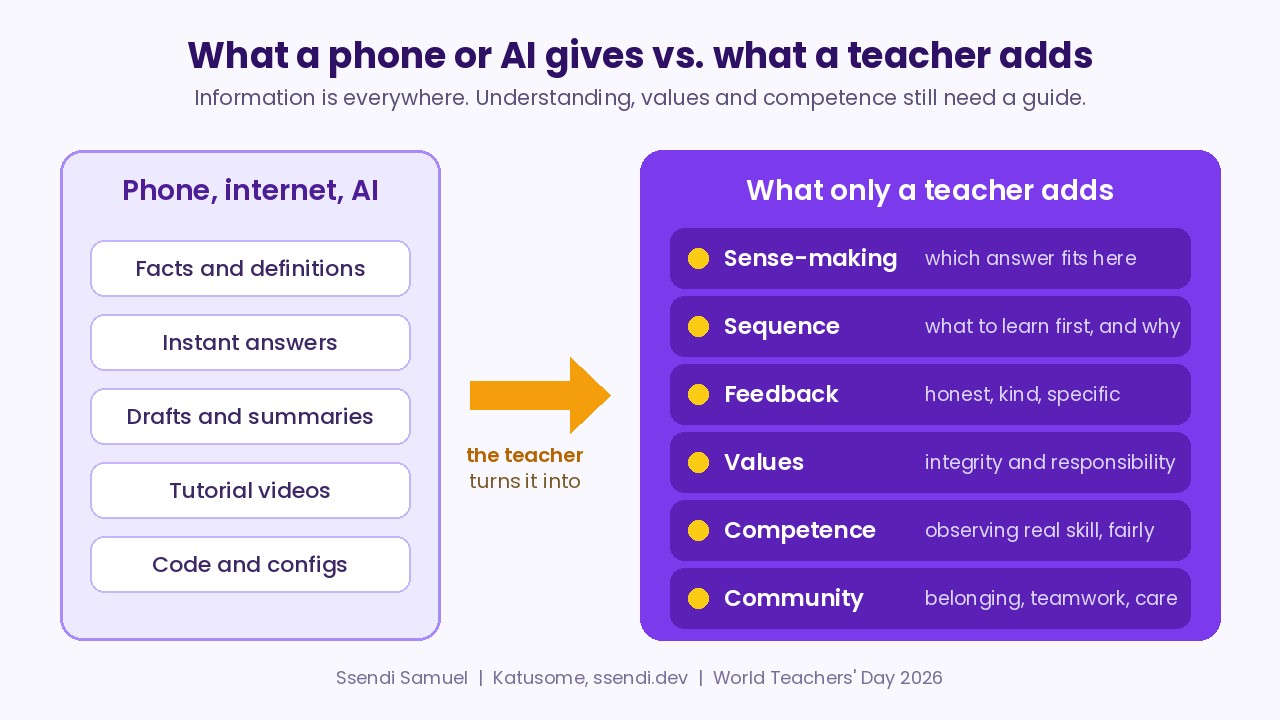
Once you see that gap clearly, the loud claim that AI will take the teacher's place starts to sound thin.
AI will never replace a good teacher
Generative AI is now part of every university conversation. My students use it. I use it too, for example to check whether an assignment can be answered by a chatbot in thirty seconds. If it can, I redesign the assignment. Tools are welcome in my classroom as long as they are used openly.
But I am clear about one thing: AI will not replace the teacher. A chatbot can produce an explanation. It cannot notice that a usually active student has gone quiet for three weeks. It cannot sit with a group that is falling apart and help them agree on how to share the work. It cannot look a learner in the eye during a viva and know whether they truly understand. And it carries no moral responsibility for what it says.
UNESCO's guidance on generative AI in education calls for a human-centred approach (UNESCO, Guidance for generative AI in education and research). Its AI competency framework for teachers puts a human-centred mindset and the ethics of AI at the top of what teachers need (UNESCO, AI competency framework for teachers). I agree with both. In the AI era the teacher becomes a guide through too much information, a moral compass, a coach, an assessor of real competence, and the person who keeps a class feeling like a community instead of a room full of screens. I have written more about this in rethinking assessment when AI can write the essay.
That word competence matters for another reason. Uganda is redesigning how we teach and assess, and that shift puts teachers at the centre again, not at the edge.
Competence-based education needs teachers more, not less
The National Curriculum Development Centre began rolling out the competency-based Lower Secondary Curriculum in 2020 (NCDC, Lower Secondary Curriculum embraced). The National Council for Higher Education has signalled that from the 2027/2028 academic year, universities should admit first-year students only to programmes aligned with competence-based education (NCHE, consultative meeting on CBE reforms). The first CBE learners are already moving up the system toward us.
Some people assume CBE means the teacher talks less, so the teacher matters less. In my experience it is the opposite. Reading from old notes is easy. Designing a task where a student must actually show a skill, watching them do it, giving useful feedback, and judging fairly whether they are competent is hard work. It needs time, manageable class sizes, working labs, and lecturers who have been supported to teach this way. CBE will succeed or fail in the hands of teachers. I wrote about the transition in From O-Level to University.
Of course, that hard work sits on top of pressures that rarely make it into speeches: large classes, projectors that fail mid-session, internet that drops as fifty students try to submit, marking that eats whole weekends. At MUBS, like many university teachers, I know what a long teaching day feels like. And still, lecturers keep doing the unseen parts: the extra consultation hour, the late-night message before an exam, the student who needs someone to listen before they need a lesson. That quiet persistence is what I want to celebrate today.
Resilience, and a thank you
Teachers are resilient. During the COVID-19 closures, Ugandan teachers kept learning going through radio lessons, printed materials and phone calls. University lecturers moved whole courses online with very little preparation, and then moved them back. Teachers in rural schools keep teaching with few books and crowded classrooms, and still produce learners who go on to lead.
A teacher's work spreads quietly. The student who learned honesty in a lab becomes the engineer who reports a security incident instead of hiding it. The learner who was encouraged to speak up in class becomes the person who speaks up for her village. That is how teachers shape communities: one person, one class, one year at a time.
So thank you. To the primary teachers who taught us to read, to the secondary teachers who were patient with our endless questions, to my colleagues at MUBS, and to every teacher in Uganda and beyond who keeps going when it is hard: your work matters more now, not less. The tools will keep changing. The need for a person who genuinely cares whether another person learns will not.
Happy World Teachers' Day.